
Free download · 2026 Edition

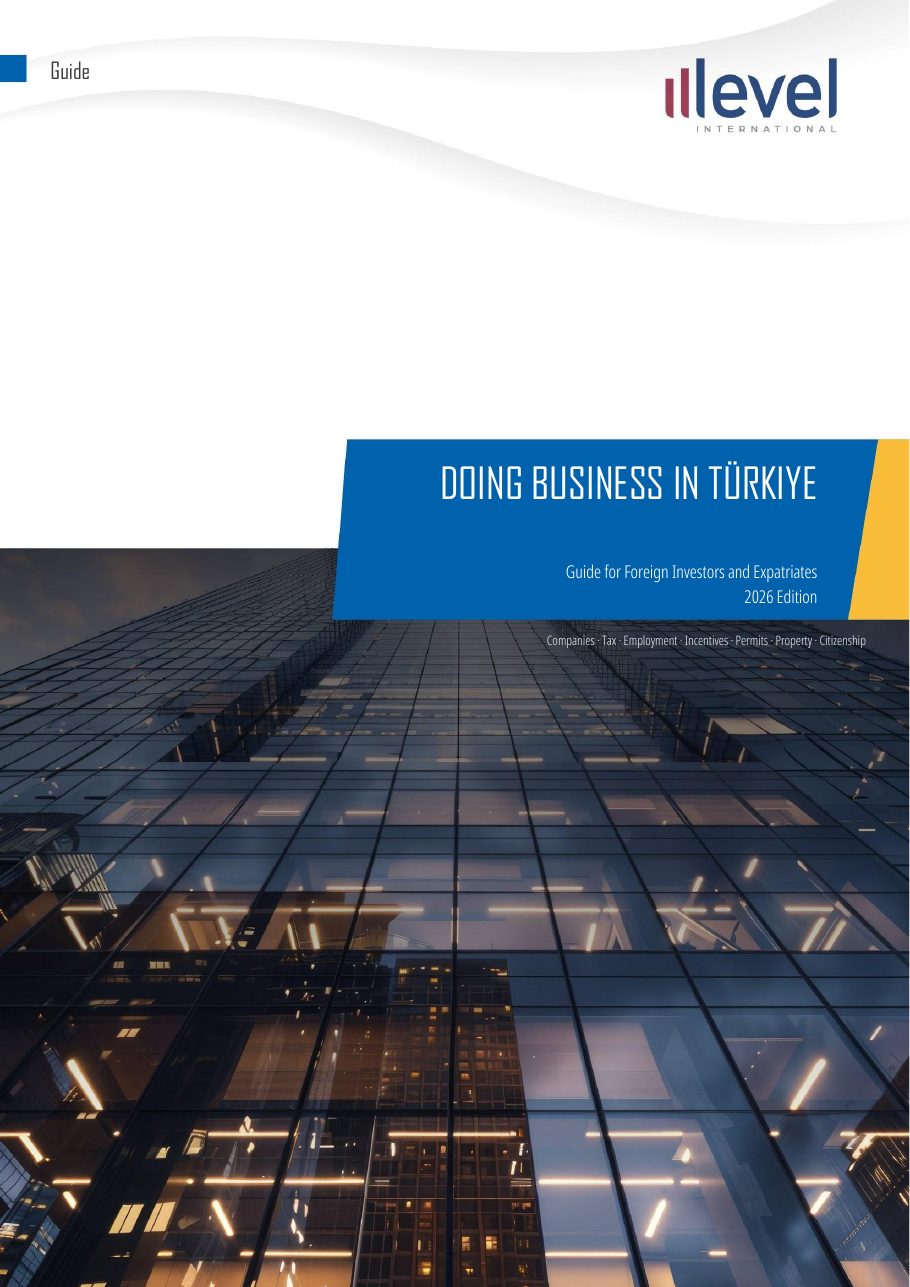
Doing Business in Türkiye

Guide for Foreign Investors and Expatriates

Companies · Tax · Employment · Incentives · Permits · Property · Citizenship

  • PDF
  • 28 pages
  • 0.8 MB
  • English
Cover of the Doing Business in Türkiye 2026 Edition guide by Level International
What's inside

17 chapters in 4 parts

“We wrote this guide to answer the questions our clients ask first: which company to set up, what taxes apply, how to hire, and how to live and work here as a foreigner.”Foreword, Level International
Download the PDF
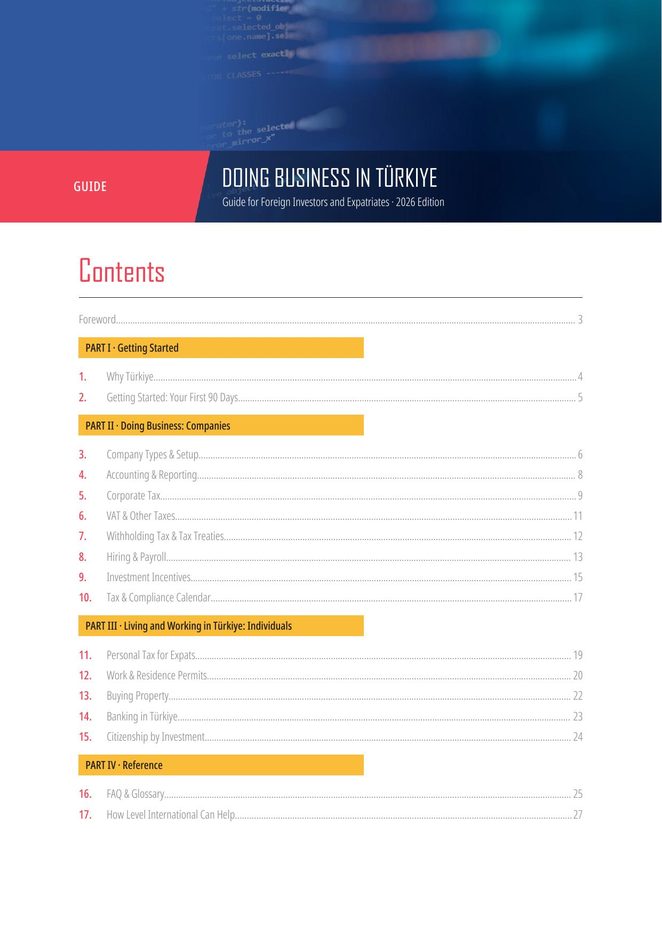
Sample page from Doing Business in Türkiye: Contents
Contents
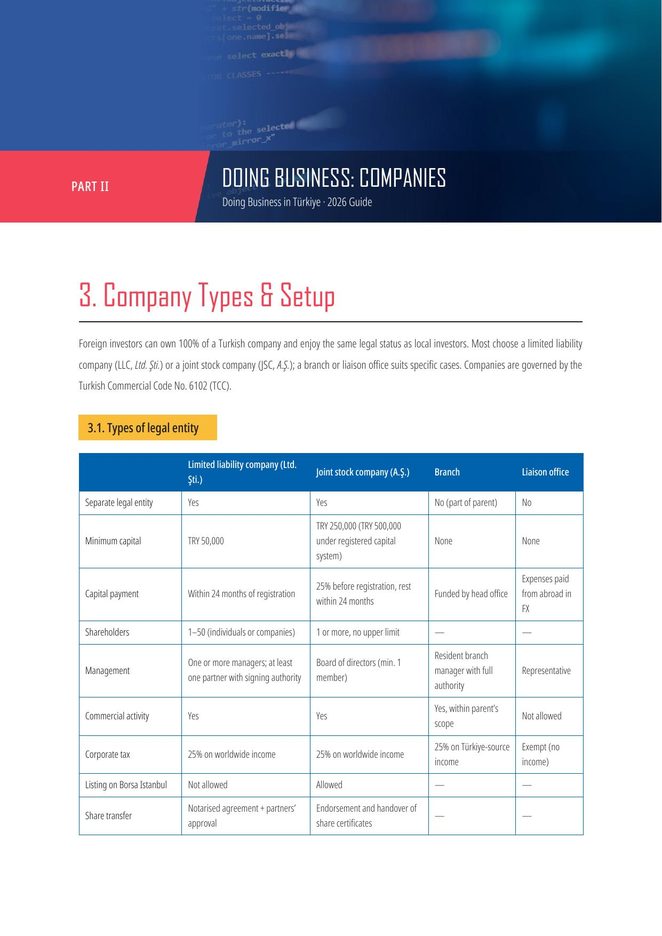
Sample page from Doing Business in Türkiye: Company Types & Setup
Company Types & Setup
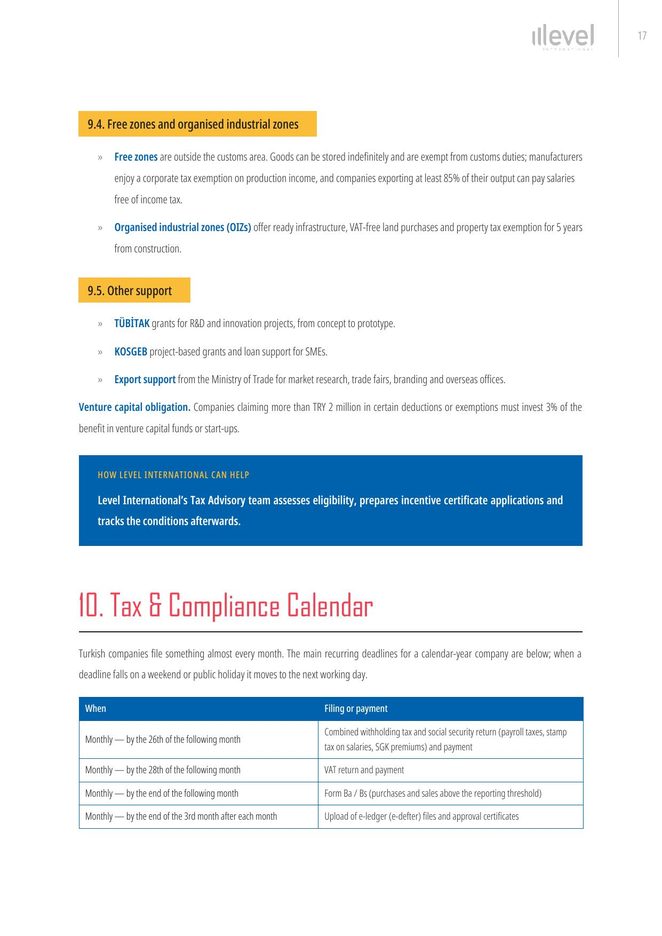
Sample page from Doing Business in Türkiye: Tax & Compliance Calendar
Tax & Compliance Calendar
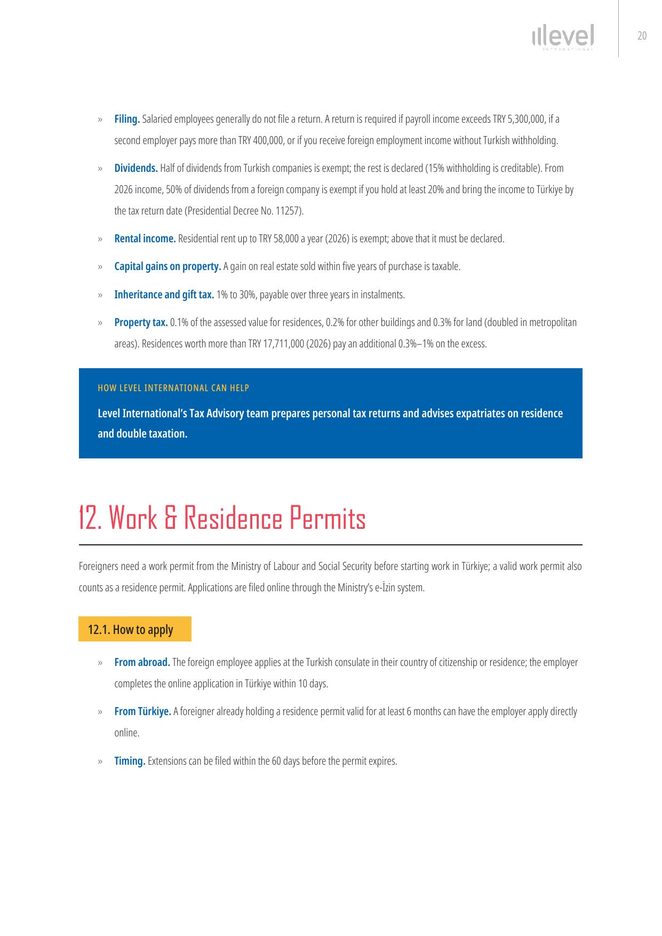
Sample page from Doing Business in Türkiye: Work & Residence Permits
Work & Residence Permits
Read online

The guide, topic by topic

Prefer to read on screen? The same topics, kept up to date on this site.

Set up

Costs, timeline and the registered office for a new Turkish company.

Doing Business · Set up

Costs & timeline of setting up a company in Türkiye

Setting up a Turkish company involves three kinds of cost: capital that stays in the company, one-off set-up costs, and monthly running costs for compliance. Registration itself can be done in a day; most foreign investors should plan for one to three weeks from start to a working bank account.

2 min read
Doing Business · Set up

Registered office & address in Türkiye

Every Turkish company must have a registered address in Türkiye. It appears in the articles of association and the trade registry, and the tax office visits it after registration to confirm the business really exists there. Choosing an address that will pass this inspection avoids delays in getting your tax registration.

2 min read

Related publications

Run

Hiring, outsourcing and, when the time comes, closing a company.

Doing Business · Run

Hiring foreign staff in Türkiye

A Turkish employer can hire foreign nationals once it obtains a work permit for them from the Ministry of Labour and Social Security. The Ministry looks at the employer as well as the employee, so it is worth checking the criteria before you make an offer.

2 min read
Doing Business · Run

Employer of record & outsourcing in Türkiye

If you want people in Türkiye before setting up a company, or want to run a Turkish company without building a local back office, you have three options: an employer of record (EOR) arrangement, setting up your own company and outsourcing payroll and accounting, or a combination of the two. Turkish law regulates temporary agency work closely, so EOR arrangements need careful structuring.

2 min read
Doing Business · Run

Closing a company in Türkiye (liquidation)

A Turkish company is closed through a formal liquidation: the shareholders decide to dissolve it, a liquidator settles its affairs, creditors are invited to claim, and only then is the company struck off the trade registry. Because of the mandatory creditor waiting period, a standard liquidation usually takes a year or more. Unpaid tax and social security debts can pass to managers and shareholders, so closing properly matters.

2 min read

Related publications

Tax

The Turkish tax system and the rules on related-party pricing.

Tax & Regulation

The Turkish tax system at a glance (2026)

Türkiye taxes companies at 25% on their profits, charges 20% standard VAT, and taxes individuals at progressive rates from 15% to 40%. Companies file monthly, quarterly and annual returns, and many TRY thresholds are revalued every January. This page summarises the main taxes; each links to a detailed guide.

2 min read
Doing Business · Tax

Transfer pricing in Türkiye

Transactions between a Turkish company and its related parties must be priced at arm's length, following OECD methods. Companies document this in an annual transfer pricing form and report; larger groups also prepare a master file and a country-by-country report. Non-arm's-length profit is treated as a disguised profit distribution.

2 min read

Related publications

Live

Practical steps for moving to Türkiye with your family.

Doing Business · Live

Relocating to Türkiye: a practical checklist

Moving to Türkiye involves a few official steps in the right order — permit, address registration, foreigner ID number — and a set of practical ones: health insurance, a bank account, schools and a phone. This checklist covers the first months. Rules on driving licences, phones and belongings change from time to time, so check the current requirements before you move.

2 min read

Related publications

Why Türkiye

Where to set up, and how trade and customs work.

Doing Business · Why Türkiye

Cities & regions: where to set up in Türkiye

Most foreign companies start in Istanbul, Türkiye's commercial and financial centre. But the right location depends on what you do: manufacturers often choose the industrial belt around Kocaeli and Bursa, exporters look at Izmir's ports, public-sector suppliers go to Ankara, and tourism businesses to Antalya and the coast. Location can also change the incentives you receive.

2 min read
Doing Business · Why Türkiye

Trade & customs: importing and exporting from Türkiye

Türkiye has been in a customs union with the European Union for industrial goods since 1996: goods travelling with an A.TR certificate move between Türkiye and the EU free of customs duty. Türkiye also has free trade agreements with many other countries, free zones for storage and manufacturing, and customs regimes that let exporters import inputs without paying duties. Imports are subject to import VAT and, for some products, additional duties.

2 min read

Related publications

2026 Edition · 28 pages

Take the guide with you.

Download the PDF to read offline or share with your finance team. For advice on your own situation, book a free 30-minute call with our advisers.